The property tax bill you see before closing may not be the tax bill you receive later. Here’s what Michigan homebuyers should understand about taxable value, SEV, uncapping, and the Principal Residence Exemption.
You find a home in West Michigan that fits your budget.
The purchase price works.
The mortgage payment looks manageable.
Then you look at the property taxes and think:
Great — I know what my annual housing cost should be.
Not necessarily.
One of the most important things Michigan homebuyers should understand is that the current owner’s property tax bill may not accurately represent what the next owner will pay.
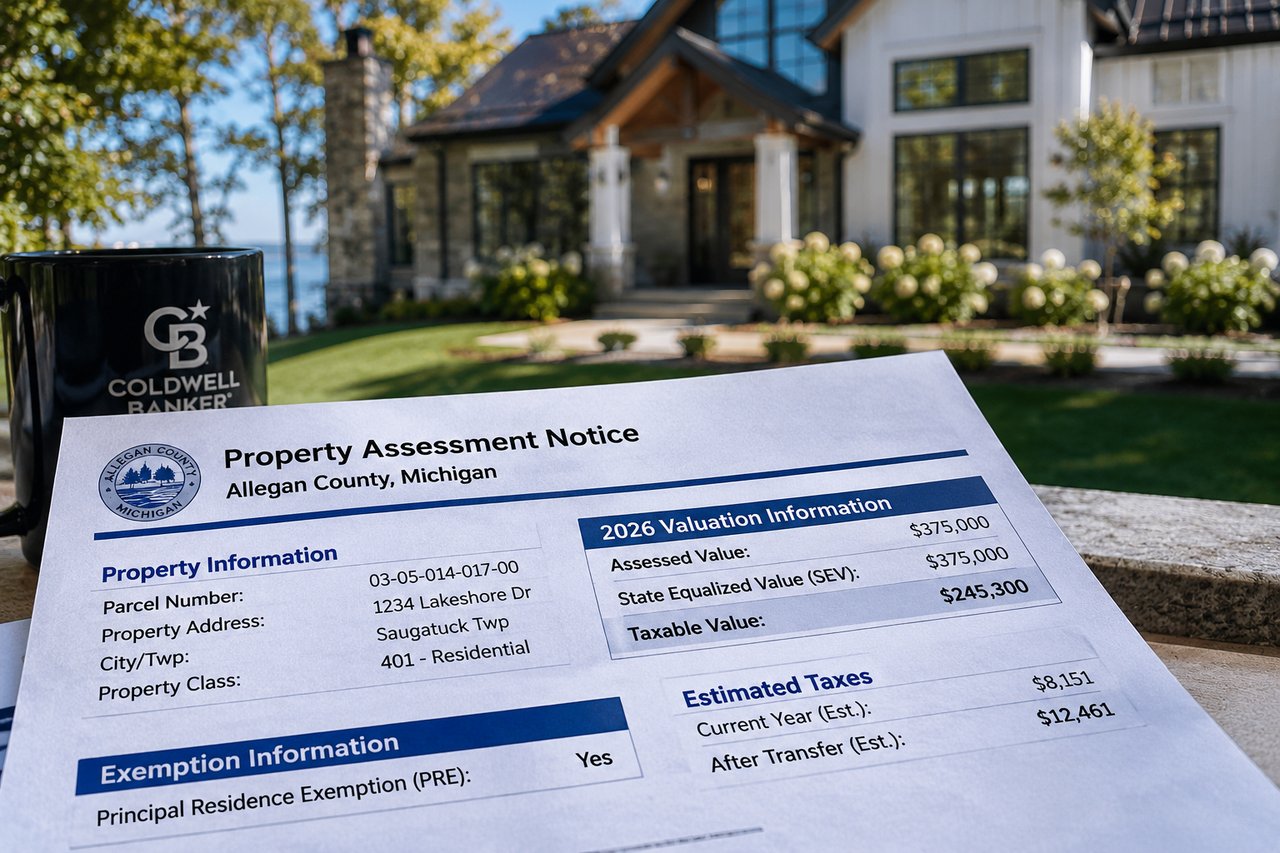
Michigan has a unique property-tax system in which a property's taxable value is generally capped while the same owner continues to own it.
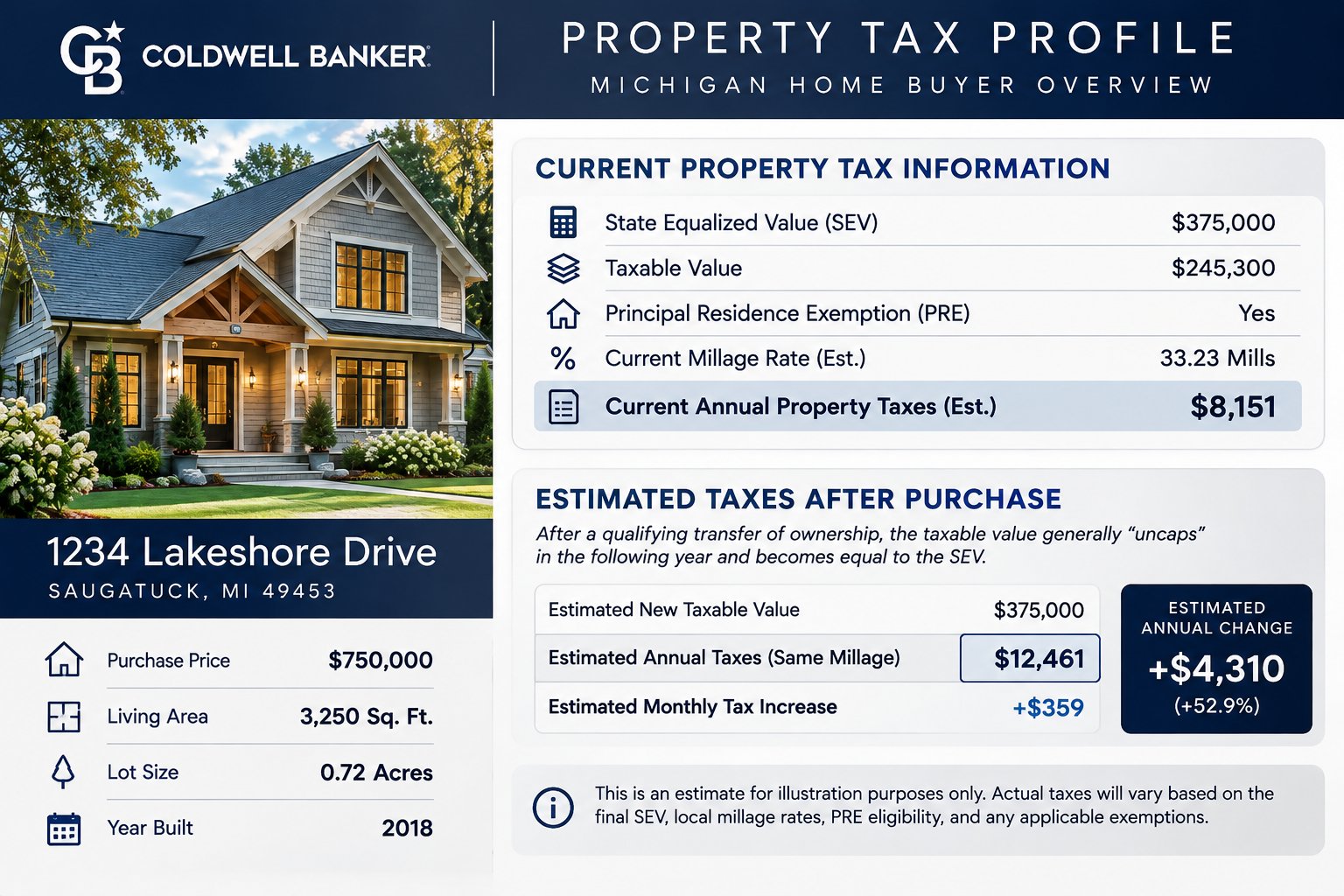
After a qualifying transfer of ownership, however, that taxable value normally “uncaps” in the following calendar yearand becomes equal to the property's State Equalized Value, or SEV.
That can result in a noticeable increase in property taxes for the new owner.
And it is something buyers should understand before deciding what they can comfortably afford.
First, Understand the Three Different Property Values
Michigan property records can show several different values.
They are related, but they do not mean the same thing.
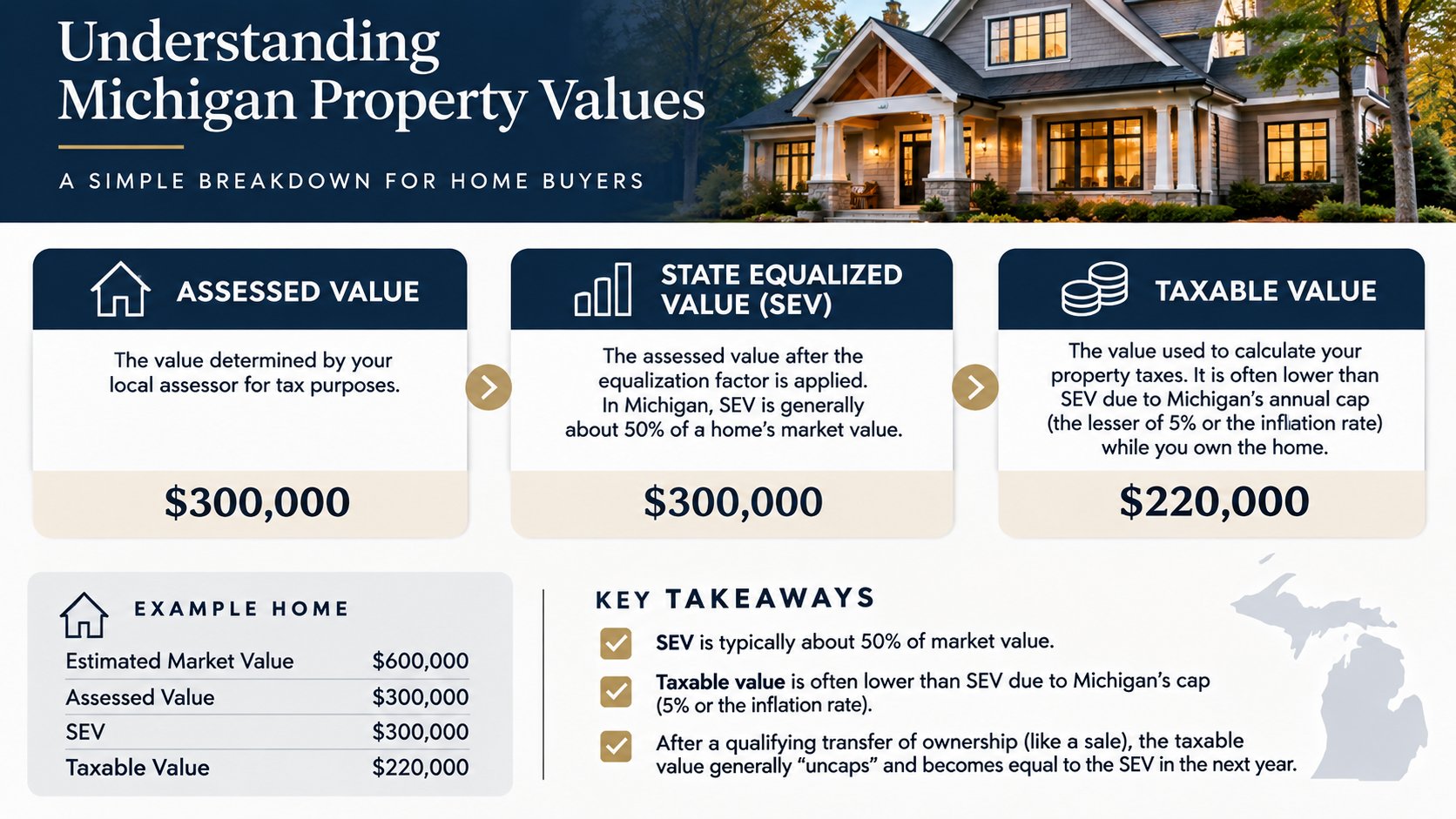
Assessed Value
Michigan assessors determine an assessed value for the property.
Generally, the State Equalized Value is intended to approximate 50% of the property's true cash value, or market value.
State Equalized Value — SEV
The State Equalized Value, commonly called SEV, is the assessed value after any applicable equalization factor.
Again, SEV should generally approximate 50% of market value.
Taxable Value
Taxable Value is the number actually used to calculate the property's taxes.
Generally:
Taxable Value × applicable millage rates = property taxes.
For homeowners who have owned a property for many years, the taxable value can be significantly lower than the SEV.
That difference is where buyers need to pay attention.
Why Can the Seller's Taxable Value Be So Low?
Michigan's Proposal A system limits how quickly taxable value can increase while a property remains under the same ownership.
Except for additions and losses, annual increases in taxable value are generally limited to the lesser of:
5%
or
the inflation rate.
For the 2026 assessment year, Michigan's inflation-rate multiplier is 1.027, meaning a 2.7% inflation adjustment is used in the capped-value calculation.
Meanwhile, a property's market value may have increased considerably faster over the years.
Imagine someone bought a home 20 years ago.
Over those 20 years, the home's market value may have increased substantially.
But because taxable value has been subject to Michigan's annual cap, the owner's taxable value may remain far below the property's current SEV.
That can result in a tax bill that looks surprisingly low to a buyer.
What Happens When the Home Is Sold?
This is where uncapping comes into play.
Michigan law generally provides that after a qualifying transfer of ownership, the property's taxable value becomes uncapped in the calendar year following the transfer.
At that point, taxable value generally becomes equal to the property's SEV for that assessment year.
For example:
Suppose a seller has:
SEV: $300,000
Taxable Value: $180,000
The seller's taxes are being calculated using the $180,000 taxable value.
After the property transfers, the following year's taxable value may uncap and become equal to the new year's SEV.
If that SEV were $305,000, for example, the new owner's property taxes would then be calculated using approximately $305,000 rather than $180,000.
That is a major difference.
Does the Taxable Value Automatically Become Half of the Purchase Price?
No.
This is an extremely important distinction.
You may hear people say:
“If you buy the house for $600,000, your taxable value will become $300,000.”
That is not necessarily correct.
Michigan's State Tax Commission specifically states that assessors cannot automatically set assessed value or taxable value at one-half of the property's sale price.
The assessor must determine the property's true cash value using the same assessment process used for other properties.
The sale price can certainly be relevant to market value.
But Michigan assessors are not supposed to simply take the sale price and divide it by two.
A Simple Example
Imagine you're purchasing a West Michigan home for $700,000.
The property currently shows:
SEV: $330,000
Taxable Value: $205,000
The current owner's taxes are based primarily on that $205,000 taxable value.
After the transfer of ownership, the property will generally uncap in the following assessment year.
If the assessor establishes the new SEV at $340,000, the property's taxable value would generally become $340,000 for that year.
That means the buyer's future tax bill could be substantially higher than the seller's current bill.
This is why simply looking at the property taxes shown on an MLS listing or real-estate website can be misleading.
The Sale Year and the Following Year Can Look Very Different
Timing is important.
The taxable value does not normally uncap the moment you sign the closing documents.
Michigan Treasury states that a transfer of ownership causes taxable value to uncap in the calendar year following the year of the transfer.
So if you buy a home in 2026, the uncapping would generally affect the property's 2027 taxable value.
That can make the first tax bills after closing confusing.
A buyer may initially see taxes that resemble what the seller had been paying, only to see them change after the next assessment.
That is why buyers should plan ahead.
What Is a Millage Rate?
Once the taxable value is determined, local millage rates are applied.
Michigan property taxes can include millages for things such as:
- Schools
- Cities or townships
- Counties
- Libraries
- Public safety
- Parks
- Transportation
- Other approved local services
The exact total millage varies considerably depending on the municipality, school district, and exemptions associated with the property.
That means two homes with identical taxable values can still have different property-tax bills depending on their location.
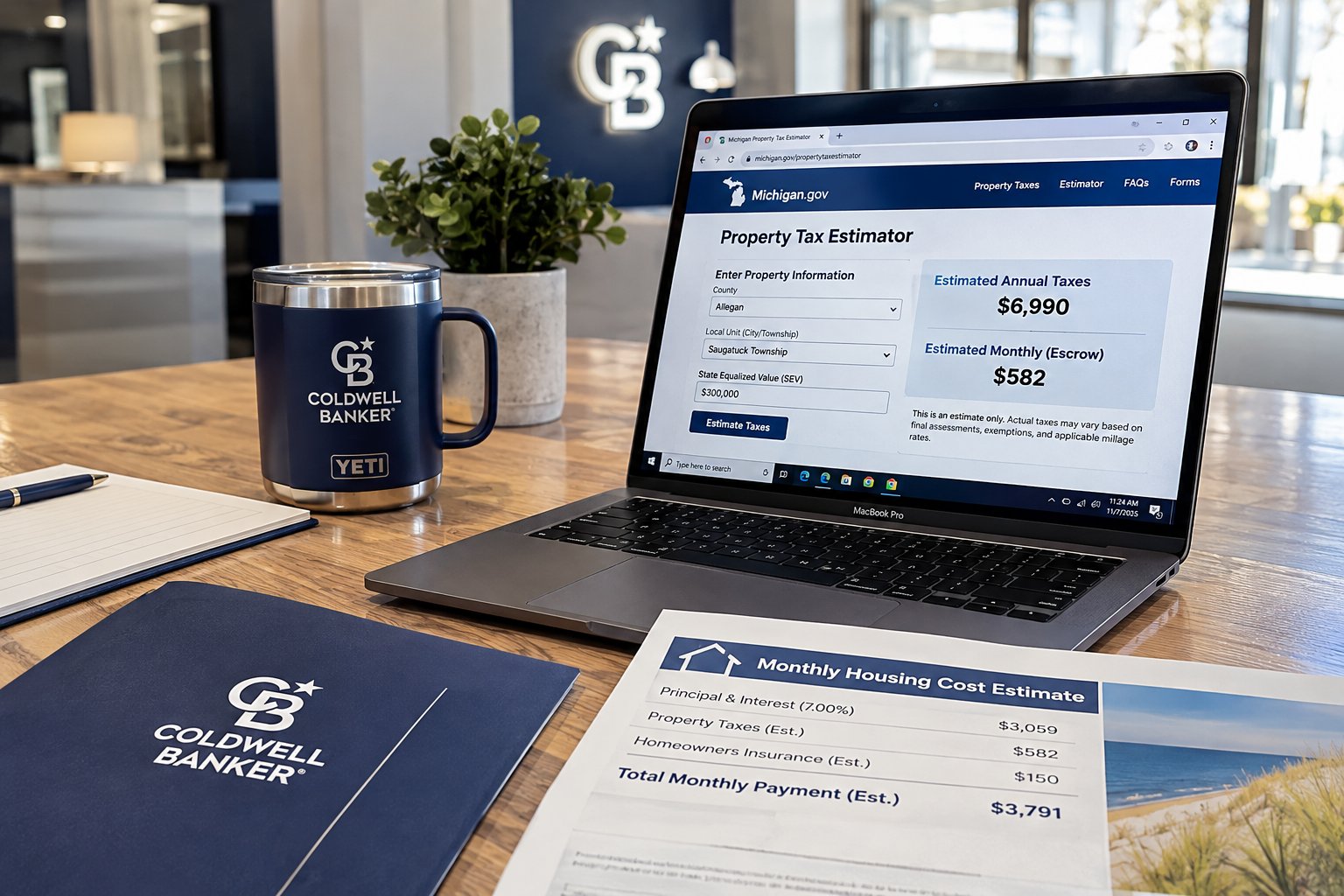
Michigan provides an official Property Tax Estimator that allows taxpayers to compare millage rates and estimate taxes by local unit.
What Is the Principal Residence Exemption?
The Principal Residence Exemption, commonly called the PRE, is another major factor in Michigan property taxes.
If you own and occupy a qualifying property as your principal residence, the PRE exempts that property from the local school operating millage of up to 18 mills.
This can make a meaningful difference in the annual tax bill.
A qualifying principal residence is generally the place where the owner has their true, fixed, permanent home and intends to return when absent.
This distinction becomes particularly important when comparing:
Primary residences
with
Second homes, vacation homes, or certain investment properties.
A Lake Michigan Second Home May Be Taxed Differently
This matters a lot in West Michigan.
Suppose someone purchases a Lake Michigan cottage in Saugatuck, South Haven, or along the lakeshore but keeps their primary residence elsewhere.
That waterfront property generally would not qualify for a Principal Residence Exemption simply because the owner spends part of the year there.
Because a PRE exempts up to 18 mills of local school operating taxes, the difference between a primary residence and a non-principal residence can be significant.
This is one reason buyers comparing second homes should carefully evaluate the non-homestead tax rate rather than assuming the previous owner's tax bill will apply to them.
Don't Assume the Seller's PRE Will Automatically Apply to You
Buyers should also confirm their own eligibility and filing requirements.
Michigan requires qualifying homeowners to file a Principal Residence Exemption Affidavit — Form 2368 with the local assessor.
For the current year, a valid affidavit filed by June 1 can apply beginning with the summer tax levy.
A qualifying affidavit filed from June 2 through November 1 can apply beginning with the winter tax levy.
Once properly established, the PRE generally continues while the owner remains eligible.
Buyers should confirm the process with the local assessor rather than simply assuming the exemption has transferred.
Why Two Neighbors Can Have Very Different Tax Bills
This surprises many buyers.
Imagine two nearly identical homes next door to each other.
Both are worth approximately $600,000.
One homeowner purchased in 2002.
The other purchased last year.
The longtime owner's taxable value may have been capped for decades.
The newer owner's taxable value may have recently uncapped.
As a result, they may have very different taxable values — and therefore very different tax bills — even though the homes have similar market values.
This is normal under Michigan's Proposal A system.
It is also why using a neighbor's taxes as your estimate can be misleading.
Why Online Listing Taxes Can Be Misleading
Real-estate websites typically display historical property-tax information.
That information can be accurate for the current owner while still being a poor forecast for the buyer.
For example, a listing might show:
Annual property taxes: $6,800
A buyer may naturally incorporate $6,800 into their budget.
But if the taxable value is scheduled to uncap after the transfer, the buyer's future bill could be considerably different.
The better questions are:
What is the current SEV?
What is the current taxable value?
Does the property currently have a PRE?
Will I qualify for a PRE?
What are the applicable millage rates?
What might taxable value look like after uncapping?
Those questions provide a much better picture.
Property Taxes Affect More Than Your Annual Budget
Property taxes are also important because most financed buyers pay them through an escrow account.
Your lender may collect part of your anticipated taxes each month along with:
- Principal
- Interest
- Homeowners insurance
If future taxes increase after taxable value uncaps, your escrow requirement may change.
That means your total monthly housing payment can increase even if your mortgage's principal and interest payment stays exactly the same.
This is one reason buyers should think in terms of their total monthly housing cost, not simply the mortgage payment.
Buyers Should Look at SEV and Taxable Value Before Making an Offer
Michigan property information is often publicly available through:
- City or township assessing records
- County databases
- BS&A Online
- GIS systems
- Property tax records
Before purchasing, buyers should review both:
State Equalized Value
and
Taxable Value.
If those numbers are far apart, that can be an indication that the current owner has benefited from years of capped taxable-value increases.
That does not tell you exactly what your future taxes will be.
But it is a strong signal that you should investigate further.
What About New Construction?
New construction can work differently because new improvements can be considered additions to taxable value.
Buyers purchasing a recently constructed or partially completed home should pay particular attention to whether the existing assessment reflects the finished home.
A tax bill based on vacant land or a partially completed structure may look extremely low compared with what the finished property's future taxes could be.
This is another situation where relying only on the current bill can create an unpleasant surprise.
Waterfront Buyers Should Be Especially Careful
West Michigan has many properties where this issue can become significant.
Consider:
- Lake Michigan waterfront homes
- Lake Macatawa
- Spring Lake
- Muskegon Lake
- Kalamazoo River properties
- Inland-lake homes
- Vacation cottages
- Luxury second homes
A waterfront home may have been owned by the same family for decades.
That can create a large gap between taxable value and SEV.
A buyer purchasing that property today may face a very different tax situation after uncapping.
And if the home will be used as a second residence rather than the buyer's principal residence, PRE treatment may also differ.
For a multimillion-dollar waterfront property, those differences can become substantial.
Don't Estimate Taxes From Purchase Price Alone
Another common shortcut is:
Purchase price ÷ 2 × millage rate.
That may provide a very rough hypothetical scenario, but it should not be represented as an exact future tax calculation.
The State Tax Commission specifically warns that assessors may not automatically assess a property at half its sale price.
A more responsible approach is to:
- Review the current SEV.
- Review the current taxable value.
- Determine whether the property has a PRE.
- Identify the applicable local millage rates.
- Consider the potential impact of uncapping.
- Consult the local assessor when greater certainty is needed.
Michigan's official Property Tax Estimator can also be useful when evaluating scenarios.
What Happens After the First Uncapped Year?
Once taxable value uncaps following the qualifying transfer, the annual cap generally returns.
Future taxable-value increases are again generally limited to the lesser of 5% or the applicable inflation rate, excluding additions and losses.
So uncapping is not something that occurs every year.
It is primarily tied to qualifying ownership transfers.
That is one of the most important concepts for Michigan buyers to understand.
Questions Buyers Should Ask Before Closing
Before purchasing a Michigan home, consider asking:
- What is the current taxable value?
- What is the current SEV?
- How long has the seller owned the property?
- Is the property currently receiving a Principal Residence Exemption?
- Will I qualify for the PRE?
- What local millages apply?
- Is this new construction or recently improved property?
- Could the taxable value uncap next year?
- What might my escrow payment look like afterward?
For properties with an unusually large gap between SEV and taxable value, it can also be worth contacting the local assessor directly.
The Biggest Mistake Buyers Can Make
The biggest mistake is simple:
Using the seller's current tax bill as if it were guaranteed to become your tax bill.
It may not.
Michigan's property-tax system rewards long-term ownership by capping annual increases in taxable value.
When a qualifying transfer occurs, that accumulated difference can disappear when the taxable value uncaps.
That does not mean buyers should be afraid of the system.
They simply need to understand it before they purchase.
The Bottom Line
Property taxes should be part of the affordability conversation before you buy a Michigan home — not after the first unexpected tax bill arrives.
The most important things to remember are:
SEV and taxable value are not the same thing.
The seller's taxable value may have been capped for years.
A qualifying transfer of ownership generally causes taxable value to uncap in the following calendar year.
The new taxable value is not automatically half of the sale price.
A Principal Residence Exemption can exempt a qualifying primary residence from up to 18 mills of local school operating taxes.
And most importantly:
The taxes shown on today's listing may not represent what you will pay after purchasing the property.
For West Michigan buyers — especially those considering waterfront, luxury, second-home, or long-held properties — understanding the tax history before making an offer can help prevent a major budgeting surprise later.